Muscle & recovery
Silent Tension Signals: Why Everyday Muscle Tightness Often Builds Up Before You Feel It
The knot in your shoulder didn't appear this morning. It's usually the end result of weeks of small, unnoticed strain.
Muscle & recovery
The knot in your shoulder didn't appear this morning. It's usually the end result of weeks of small, unnoticed strain.

Muscle tension accumulates in small increments long before it registers as noticeable soreness.
Key takeaways
Most muscle tightness doesn't arrive suddenly. It accumulates — a slightly hunched shoulder here, a tensed jaw during a stressful call there, an hour too long at a desk without moving. Individually, none of it registers. Collectively, it's often what's behind the stiffness that eventually shows up in the neck, shoulders, or lower back.
Because the buildup is gradual, it's easy to treat the resulting soreness as a one-off event rather than the cumulative result it usually is.
This article looks at why that buildup happens, who tends to notice it first, how to recognize the early signs, and what to weigh before adding a massage routine to help manage it.
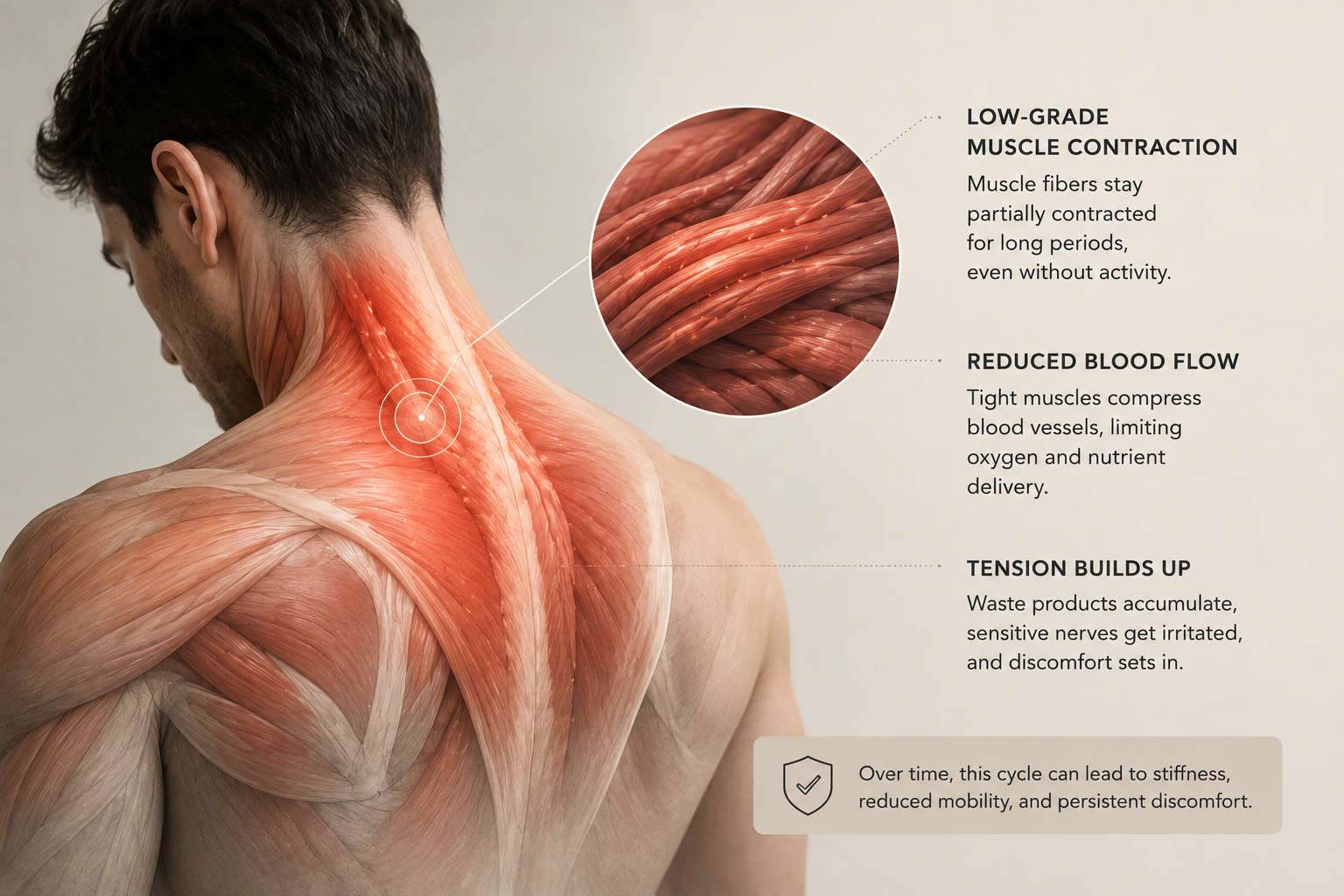
Muscle fibers can stay in a low-grade state of contraction for extended periods without producing an obvious symptom.
Muscles are designed to contract and release. Under sustained postural or emotional stress, some fibers stay in a low-grade, partial contraction for extended periods — a pattern sometimes described as muscle guarding. It's a protective reflex, not a malfunction, but it comes at a cost: restricted circulation, reduced flexibility, and a gradual buildup of tension in the surrounding tissue.
Tightness rarely comes from one bad movement. It's usually the accumulated cost of many small, sustained ones.
Because this low-grade contraction doesn't hurt on its own, it tends to go unaddressed until the cumulative tension crosses a threshold — showing up as stiffness, a tension headache, or a tender knot that's suddenly impossible to ignore.
A combination of factors influences how much tension accumulates and how quickly: how much of the day is spent in one position, how physically demanding recent activity has been, how well-hydrated the tissue is, and how much unmanaged stress the body is carrying.
None of these produce an obvious symptom in the moment. Sitting slightly hunched doesn't hurt at minute ten. A stressful week doesn't announce itself as tension building in the trapezius. The feedback tends to arrive later — and cumulatively — rather than as a clear, immediate signal.

Several ordinary daily habits contribute cumulatively to muscle tightness.
Long stretches in a single seated position are one of the most common contributors to neck and shoulder tension.
Repeated physical demand without adequate recovery time between sessions.
Sustained mental or emotional load is a well-documented trigger for low-grade muscle guarding.
Less frequent movement throughout the day can allow tension to accumulate with fewer natural breaks.
Precise assessment of tissue tension requires a trained hand, but a few everyday clues are worth paying attention to:
None of these on their own point to anything serious — tension naturally fluctuates with activity, sleep, and stress. What matters is whether a pattern keeps returning to the same area over weeks, which is a sign the underlying cause hasn't been addressed.
Leaving persistent tension unaddressed for an extended period is generally associated with more pronounced stiffness, a narrower comfortable range of motion, and a higher chance that a simple routine adjustment will need to be paired with more deliberate recovery work later on.

Why supporting recovery matters more than you might think.
The topical massage-support category is crowded. A few criteria help separate a genuinely useful addition to a routine from something that mostly adds cost without much benefit:
A single application does little on its own. Value tends to come from a formula pleasant enough to use as part of a regular routine.
Worth checking whether the ingredients used have a documented history — either traditional or in published research — rather than an opaque "proprietary blend."
Non-greasy, easily absorbed formulas tend to fit more naturally into a hands-on massage routine than heavy oils or balms.
Clear usage guidance — where it can be applied, how much, and what to avoid — matters more here than in an occasional-use product.
Recognizable botanicals and minerals rather than an opaque blend.
A formula that fits into a routine without leaving heavy residue.
Flexible enough for shoulders, back, joints, and extremities alike.
Straightforward instructions on how, where, and how often to apply.
With those criteria in mind, it's worth looking at how one specific product in this category holds up — and what it's actually formulated with.
One option in this category
Among the topical massage gels available today, this article highlights one example — a botanical gel meant to be massaged directly into the skin as part of an existing recovery or relaxation routine.
It isn't the only option on the market, and it's presented here purely to illustrate how the criteria above translate into an actual product: Kinzeno Natural Massage Gel.

The formula combines minerals and botanicals with a documented history in topical application: magnesium (sulfate and chloride) alongside MSM (dimethyl sulfone), a naturally occurring sulfur compound; arnica montana and frankincense (Boswellia carterii), both traditionally used in topical formulations; a B-vitamin complex; vitamin E for its antioxidant and skin-conditioning properties; and horse chestnut extract (aescin).
It's designed as a cooling, non-greasy gel rather than a heavy oil or balm, which is part of what makes it practical for regular massage use across different areas of the body.
For context, here's how occasional massage sessions generally compare to a consistent, at-home topical routine:
| Criteria | Occasional massage sessions | Consistent at-home routine |
|---|---|---|
| Frequency | Sporadic, scheduled around availability | As often as needed, built into daily life |
| Cost over time | Higher per session | Lower, spread across regular use |
| Ease of addressing new tension | Limited by appointment availability | Can be addressed as it arises |
| Hands-on professional technique | Yes | No — self-applied |
| Replaces professional care for persistent pain? | No | No — it's a complementary daily habit |
Topical massage gels are designed to enhance a massage routine — supporting a smooth application experience on areas such as the shoulders, neck, back, and joints. They are for external use only and are not intended to diagnose, treat, cure, or prevent any disease.
Common ingredients include magnesium compounds, MSM (a naturally occurring sulfur compound), botanicals such as arnica and frankincense, B-vitamins, vitamin E, and horse chestnut extract — selected for a pleasant topical application experience.
A small amount is generally applied to the desired area and massaged gently into the skin. It's for external use only — avoid contact with eyes and mucous membranes, and wash hands after application.
Most formulas in this category are designed for use across multiple areas, including the shoulders, neck, lower back, knees, hands, and feet, as part of a broader massage or recovery routine.
Many formulas are designed to be gentle enough for regular use, but it's worth discontinuing use if irritation occurs and consulting a healthcare professional if you have an existing medical condition.
Return and refund terms vary by manufacturer. Many brands in this category offer a satisfaction window during which unused product can be returned — always check the specific policy before purchasing.
Yes. Anyone with an existing medical condition, or who is pregnant or nursing, should consult a healthcare professional before adding a new topical product to their routine.
Muscle tension rarely comes from a single dramatic event — it accumulates from small, sustained patterns: posture, stress, repetitive movement, and how much recovery time the body actually gets. Recognizing the early, easy-to-miss signals and building a consistent routine around them tends to matter more than reacting only once discomfort is already pronounced.
There are several ways to support that routine, from professional massage sessions to at-home topical products. The gel highlighted above is one example of the second category, formulated for regular, hands-on use — but the right approach for any individual should factor in personal history, activity level, and, where relevant, guidance from a healthcare professional.
Prepared by the Recovery & Ease Journal editorial team from publicly available product information and general muscle-physiology literature. Not a substitute for professional medical advice.
Pricing, availability, and return terms can change. Tap below to see the most up-to-date details directly from the manufacturer.
See full detailsThis content is for informational and educational purposes only. It does not replace professional medical advice, diagnosis, or treatment. Results can vary from person to person. Prices, specifications, and policies mentioned are the responsibility of the manufacturer and may change without notice — always confirm current information directly with the manufacturer before making a purchase decision.
Affiliate disclosure: this page may contain links to third-party products. If you make a purchase through one of these links, we may earn a commission at no extra cost to you. This does not influence the information presented above.